In each brand (Hoya Vision, Hoya One Vision, Sensity Lenses, Seiko Vision and Pentax Optical) the Google Analytics ID and Google Tag Manager ID are located in the Settings page under the Google/Tracking tab:
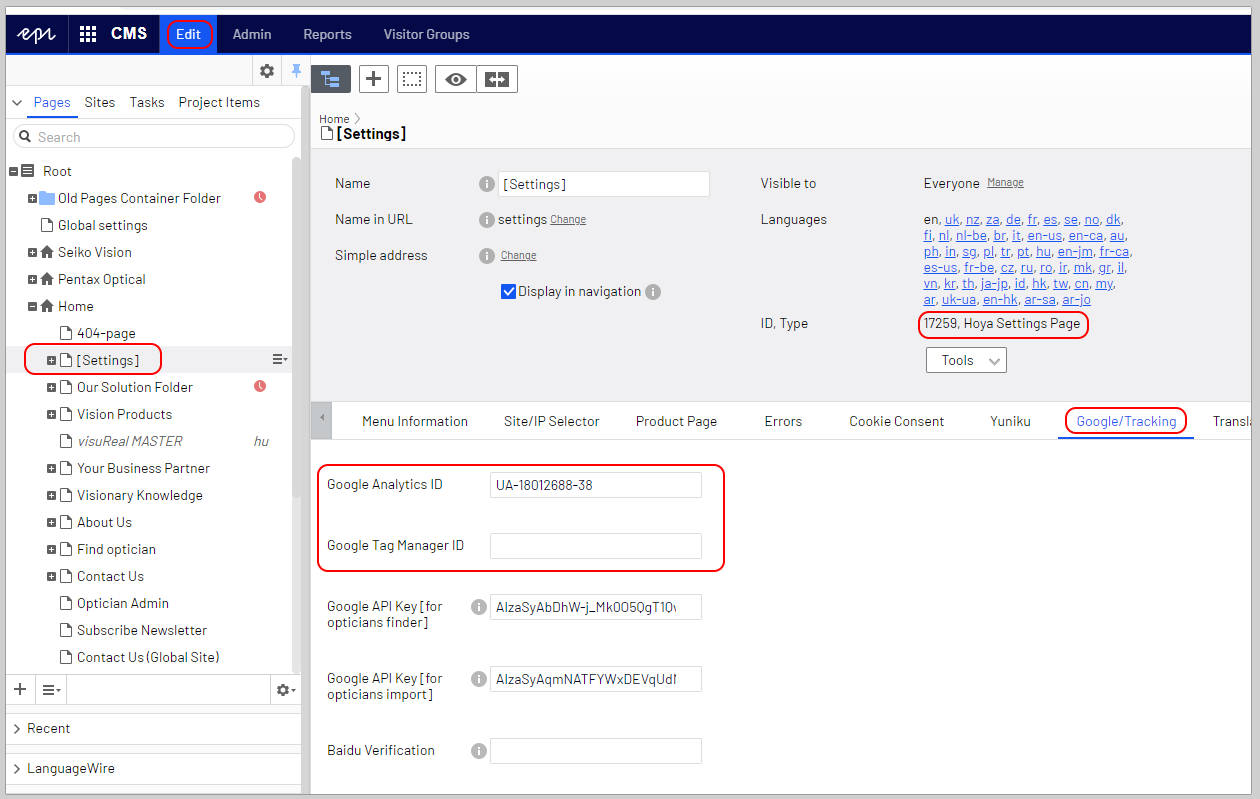
N.B. These IDs are changeable per language (CultureSpecific).
These ids are used to rendered, in the source code of the page, the respectively scripts: Google Analitytics script and Google Tag Manager script / Google Tag Manager noscript .
Google Analytics ID
The Google Analitytics script will not be rendered in the source code of the page:
- If this id is left empty or
- If this id is left NOT empty but the Settings page → tab: Cookie Consent → check-box: Use Cookiebot
 is checked.
N.B. This rule is applied only for the brands: Hoya Vision, Hoya One Vision, Sensity Lenses. For the brands: Seiko Vision and Pentax Optical this rule is not applied, therefore if this id is left NOT empty the Google Analitytics script will be rendered.
The script generated is located in the top body of the source page:
<script>
(function(i,s,o,g,r,a,m){i['GoogleAnalyticsObject']=r;i[r]=i[r]||function(){
(i[r].q=i[r].q||[]).push(arguments)},i[r].l=1*new Date();a=s.createElement(o),
m=s.getElementsByTagName(o)[0];a.async=1;a.src=g;m.parentNode.insertBefore(a,m)
})(window,document,'script','https://www.google-analytics.com/analytics.js','ga');
ga('create', 'UA-18012688-38', 'auto');
ga('send', 'pageview');
</script>
Google Tag Manager ID
The Google Tag Manager scripts will alway be rendered in the source code of the page even if this id is left empty, in this case the following default ids will be used per brand:
- Hoya: GTM-W3VRWHS
- Hoya One Vision: GTM-W3VRWHS
- Sensity Lenses: GTM-MBD43G3
- Seiko Vision: GTM-WHQW9MR
- Pentax Optical: GTM-5F4NQ87
The first script generated is located in the top head of the source page:
<!-- Google Tag Manager -->
<script>
(function (w, d, s, l, i) {
w[l] = w[l] || []; w[l].push({ 'gtm.start': new Date().getTime(), event: 'gtm.js' });
var f = d.getElementsByTagName(s)[0],
j = d.createElement(s),
dl = l != 'dataLayer' ? '&l=' + l : '';
j.async = true;
j.src = 'https://www.googletagmanager.com/gtm.js?id='+i+dl;f.parentNode.insertBefore(j,f);
})(window, document, 'script', 'dataLayer', 'GTM-W3VRWHS');
</script>
<!-- End Google Tag Manager →
The second script generated is located in the top body of the source page:
<!-- Google Tag Manager (noscript) -->
<noscript>
<iframe src="https://www.googletagmanager.com/ns.html?id=GTM-W3VRWHS" height="0" width="0" style="display:none;visibility:hidden"></iframe>
</noscript>
<!-- End Google Tag Manager (noscript) →