

Protecting your patients' vision is your most fundamental responsibility, and that responsibility doesn't clock out when the sun goes down. UV exposure is a cumulative, year-round threat, and with approximately 66% of patients reporting moderate to severe light sensitivity, the conversation about sun protection belongs in every exam room, as well as in front of the sunglass display.
And you have something no online retailer can replicate: the ability to assess, advise, and prescribe. Consider this—47% of online eyewear buyers purchased multiple pairs of glasses, compared to only 32% of in-person buyers, according to the Consumer inSights Q1 2026 report from The Vision Council.
Online retailers don't have the advantage of face-to-face interactions, professional expertise, or personalized recommendations. Yet they're successfully helping consumers see the value of owning multiple pairs, including prescription sunwear. With your clinical insight and patient relationships, you're already ahead. A strategic approach to sun lens dispensing is all it takes to make that advantage count.
The "One Size Does Not Fit All" Approach
Your patients don't all live the same life outdoors. One patient is chasing their kids around a sun-drenched soccer field; another is commuting into blinding morning glare; a third is an avid weekend boater who complains about reflection off the water every time they sit down in your chair. A single sunglass recommendation can't serve all of them equally well, and it doesn't have to.
Your role isn't simply to recommend sun protection. It's to match the right technology to the right patient in a way that maximizes both compliance and visual comfort. Patients who feel seen, and whose lenses actually fit their life, are far more likely to wear them consistently. That means better outcomes for your patients and it also means they’re forming a stronger relationship with your practice. A simple starting point: Lifestyle profiling. By identifying how and where a patient spends time outdoors, you can quickly narrow the field to the solution that will genuinely work for them. Here are three patient profiles with HOYA product recommendations to help you get started.
The Rough-and-Tumble Trendsetter
This patient wants to look good, full stop. However, they're also hard on their eyewear. They wear their sunwear daily, through everything from outdoor workouts to weekend errands, and they need lenses that can keep up without losing their edge. The classic pitch of "fashion OR durability" isn't going to cut it here. They want both.
Frame it this way:
Premium aesthetics and heavy-duty performance aren't mutually exclusive anymore. HOYA Lumacore™ Sun Lenses embed the mirror inside the lens rather than coating the surface, delivering longer-lasting, more durable performance that's engineered to resist the kind of daily wear that chips or peels a traditional mirror coating. For patients who don't baby their glasses (and most don't) that's a meaningful upgrade. Lead with the look, back it up with the durability story, and let this premium offering close the sale.
The Glare-Weary Commuter
This patient brings up glare almost every visit: blinding reflections off the road during the morning commute, off the water during a weekend on the boat, off the pavement during a run. They may already own sunglasses, yet if those lenses aren't polarized and UV-rated, they're not getting the protection or the performance they need.
Frame it this way:
The pitch here goes beyond comfort. It's about safety and reaction time. HOYA polarized lenses reduce glare and enhance contrast to provide improved visual performance, comfort, and protection, a combination that resonates with performance-driven patients and safety-conscious ones alike. For patients who drive regularly or spend time near water, reduced glare isn't a luxury feature; it's a clinical recommendation.
The One-and-Done Minimalist
This patient resists carrying two pairs of glasses. They'll forget the sunwear in the car, leave it on the counter, or simply decide it's not worth the hassle, which means they're heading outside without adequate protection more often than not. The solution isn't to convince them to change their habits. It's to prescribe something that works with their habits.
Frame it this way:
The Sensity® Family of light-reactive lenses provides a range of solutions for visual comfort and UV protection suited to every patient, from the all-day wearer to the light-sensitive patient who needs lenses that darken behind the wheel. When patients understand that their lenses will automatically adapt to changing light conditions, the compliance barrier largely disappears.
This is also a great moment to use HOYA LensPreview™ with your patients. For the patient who's skeptical about how a light-reactive lens will actually look or perform, HOYA LensPreview™ lets them see it before they commit, virtually, in your office, with true-to-color accuracy. Available for free on the HOYA Hub™, LensPreview™ has been shown to drive nearly an 11% increase in Sensity sales and a 36% increase in mirror sales among early adopters.¹ For the reluctant patient, seeing is believing.
Check out our demo video here and contact your HOYA Sales Consultant for additional training and support.
Talking Points for Patient Conversations: Misconceptions & How to Respond
Every ECP knows the feeling: You’re ready to recommend a premium sun solution, and the patient says something that stops the conversation cold. Whether it’s a misconception about tint darkness, polarization, or seasonality, don’t let these misunderstandings cost your patients protection or your practice opportunities. Here’s how to address the most common concerns head-on:
- Misconception #1: “Darkness = Safety”
- It's intuitive. It's also wrong, and biology makes a compelling counter-argument.
- Dark tints without UV400 protection cause the pupil to dilate in response to reduced visible light. That dilation opens the door to more unfiltered UV radiation reaching the retina, not less. This means a cheap, dark lens with no UV rating can actually leave a patient's eyes more exposed than wearing nothing at all. A dilated pupil also reduces visual acuity.
- The takeaway for patients: it's not about how dark the lens looks. It's about what the lens blocks.
- Misconception #2: “Polarized = UV Protected”
- Polarization and UV protection are two different things, and patients often assume they come together.
- Polarization eliminates horizontal glare (the kind that bounces off roads, water, and dashboards), which improves comfort and visual performance. This doesn't automatically block UV light, though.
- A lens needs to be explicitly rated for UV400 protection to safeguard against long-term eye damage. When recommending HOYA polarized lenses, it's worth pointing out that you're prescribing for both: comfort and health.
- Misconception #3: The “Summer Only" Fallacy
- UV damage doesn't take a winter break. It accumulates year-round: on cloudy days, during winter sports, and especially during the daily commute, where low-angle winter sun and dashboard reflection combine for some of the most significant UV exposure of the year.
- In fact, research found that the risk of a life-threatening car crash is 16% higher during bright sunlight than in normal weather.
- Remind patients that consistent sun protection is a year-round habit, not a seasonal accessory, and that the damage they're accumulating today won't show up until it already has.
Your patients trust you to see beyond the surface, and when it comes to sun protection, that's exactly what's required. The right prescription sunwear isn't just a second pair; it's a clinical recommendation that protects long-term eye health, improves daily visual performance, and keeps patients coming back to you for guidance they can't get anywhere else.
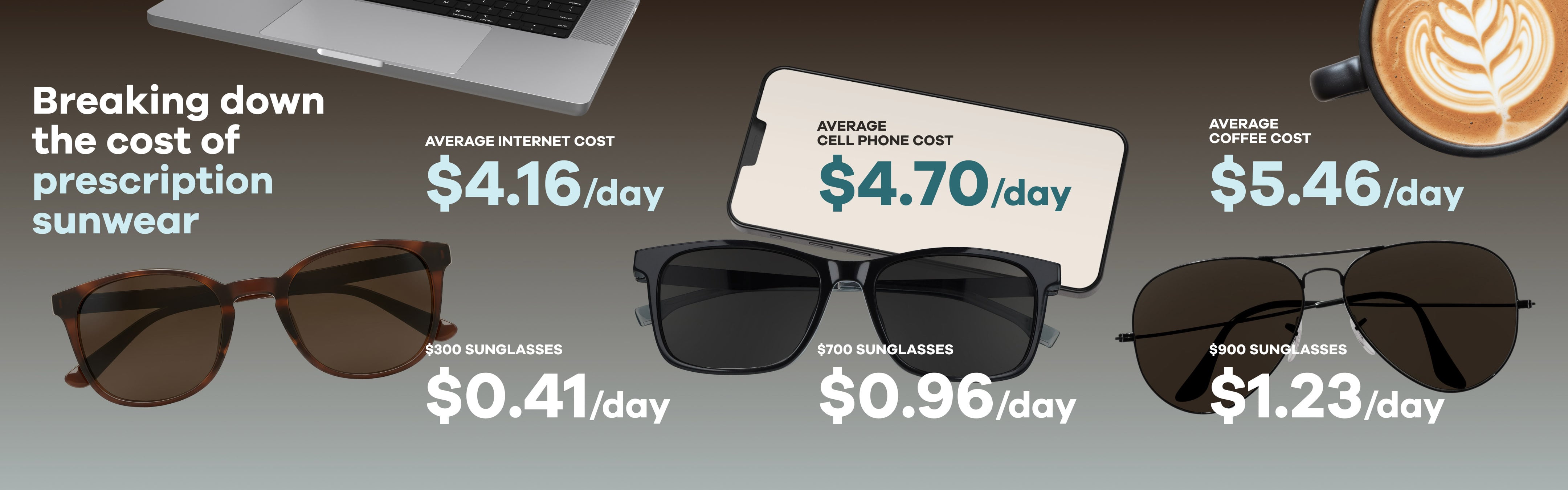
Ready to match every patient with their best sun solution? Explore the full HOYA Sun Portfolio, try HOYA LensPreview™ on the HOYA Hub™, or share the "What Is Your Vision Worth?" visual (below) to help patients understand the real value of investing in their eye health.
The best sun solution for your patient is the one they'll actually wear, and you're the one qualified to prescribe it.